


1. Background
IPPF is a global healthcare provider and a leading advocate of sexual and reproductive health and rights (SRHR) for all. Led by a courageous and determined group of women, IPPF was founded in 1952 at the Third International Planned Parenthood Conference. Today, we are a movement of 150 Member Associations (MAs) and Collaborative Partners (CPs) with a presence in over 146 countries.
Our work is wide-ranging, including comprehensive sex education, provision of contraceptive, safe abortion, and maternal care and responding to humanitarian crises. We pride ourselves on being local through our members and global through our network. At the heart of our mission is the provision of – and advocacy in support of – integrated healthcare to anyone who needs it regardless of race, gender, sex, income, or how remote their location is.
Vulnerability Assessment (VA) is a core component of IPPF’s approach to ensuring that services reach those most in need. The VA Toolkit provides MAs with guidance and practical tools to assess and report on client vulnerability, enabling IPPF to fulfil its commitment to equity-focused service delivery. Consistent and rigorous VA enables MAs to identify, prioritise, and serve marginalised, under-served, and hard-to-reach populations across diverse contexts.
Since the introduction of the VA Toolkit, feedback from MAs has highlighted a number of challenges related to conceptual clarity, usability in diverse and low-resource settings, and consistency in how vulnerability is defined, measured, and reported. A review of MA survey data on vulnerability classification and reporting – as well as relevant sector resources, client exit interview (CEI) tools, and poverty measurement frameworks – has further confirmed the need for a comprehensive revision of the toolkit.
The revised VA Toolkit aims to:
- Strengthen clarity of concepts and terminology (e.g. vulnerability, marginalisation, under-served) to ensure consistent application across MAs and contexts to inform and strengthen service delivery that is equitable and responds to the needs of all IPPF’s clients.
- Ensure language is appropriate, non-stigmatising, and aligned with inclusive and rights-based approaches.
- Improve usability and practical guidance, including adaptable approaches for different resource settings and data collection approaches.
- Incorporate examples from MA practice and integrate findings from consultations with MAs.
- Support MAs to assess vulnerability in ways that are feasible, context-appropriate, and sensitive to local realities.
2. Objective of the Consultancy
The primary objective of this consultancy is to revise and support uptake of the Vulnerability Assessment (VA) Toolkit to improve clarity, usability, and consistency in how Member Associations assess and report on vulnerability, while strengthening inclusive, rights-based and context-responsive approaches to vulnerability assessment.
Phase 1, consisting of an initial evidence review, internal consultations, and scoping, has already been conducted by an IPPF team member. The consultant will work alongside them, familiarising themselves with these initial outputs and building on this work to provide targeted technical input to the subsequent phases of the revision process.
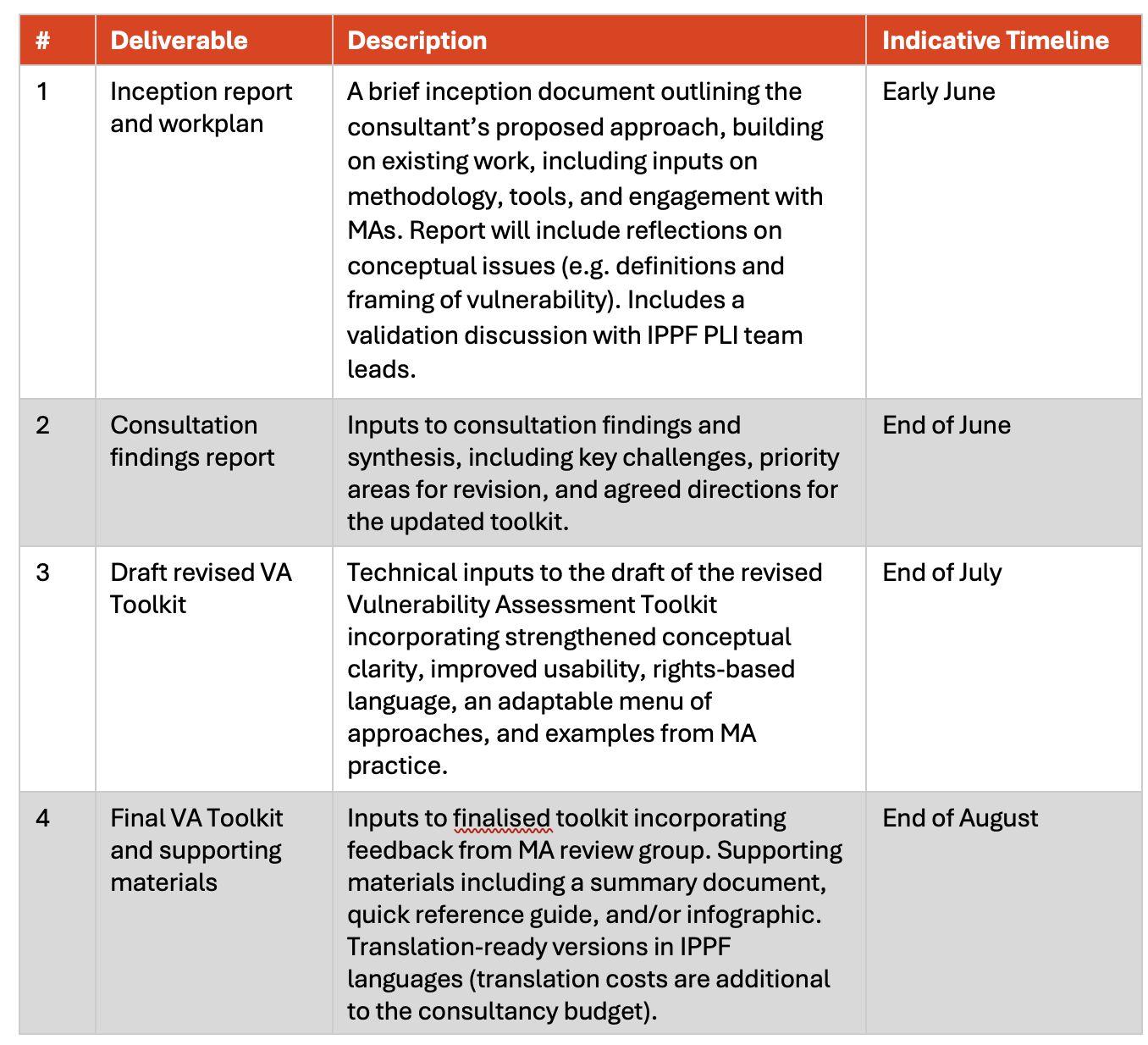
The consultant will provide an estimated ten days of work to support the following phases:
- Phase 2: MA consultations (May- June)
- Phase 3: Toolkit revision and drafting (June - July)
- Phase 4: Feedback, finalisation, and uptake support (July - August)
3. Scope of Work
The consultant will support the following activities across the remaining phases:
Phase 2: MA Consultations (May - June)
- Explore feasible and context-appropriate approaches to assessing vulnerability, including considerations for low-resource and sensitive data environments.
- Support targeted consultations with approximately 5–7 MAs across different contexts, including participation in a small number of consultations where timing allows.
- Support review and synthesis of consultation findings, including identification of key challenges MAs face in assessing vulnerability and collecting data, and identify what guidance and support would be most useful in the updated toolkit.
Phase 3: Toolkit Revision and Drafting (June)
Provide technical input to the development of a revised VA Toolkit that:
- Strengthens clarity of concepts and terminology (e.g. vulnerability, marginalisation, under-served).
- Ensures language is appropriate, non-stigmatising, and aligned with inclusive and rights-based approaches.
- Improves usability and practical guidance for MAs.
- Incorporates an adaptable “menu of approaches” reflecting different contexts and resource levels.
- Integrates examples from MA practice and findings from Phase 2 consultations.
Phase 4: Feedback, Finalisation, and Uptake Support (July - August)
- Support sharing of the draft toolkit with a small group of MAs (3–5) for feedback on usability, clarity, and feasibility.
- Support refinement of the toolkit based on feedback received.
- Finalise the toolkit for publication.
- Support translation of the toolkit into IPPF’s core languages (Arabic, English, French, Spanish).
- Contribute to the development of supporting materials (e.g. summary document, infographic, quick reference guide).
- Support early dissemination and engagement with MAs.
4. Deliverables
5. Required Qualifications and Experience
Technical Expertise
- Technical expertise in vulnerability assessment and framing of key concepts/language.
- Strong experience in the design, development, or revision of technical guidance tools, toolkits, or programmatic frameworks, ideally within the health, SRHR, or development sectors.
- Demonstrated understanding of vulnerability, marginalisation, and equity-focused approaches to service delivery, with familiarity with relevant frameworks and approaches (e.g. multi-dimensional / household level vulnerability tools, livelihood and poverty measurement tools, disability inclusion assessments, community-based vulnerability assessment approaches).
- Experience developing practical guidance materials that are accessible and applicable across diverse contexts.
Consultancy and Analytical Skills
- Proven ability to conduct evidence reviews, stakeholder consultations, and needs assessments.
- Strong skills in synthesising diverse inputs into clear, actionable, and user-friendly guidance documents.
- Ability to propose practical, scalable, and context-appropriate solutions within resource-limited settings.
- Ability to work independently, meet deadlines, and produce high-quality outputs with limited supervision.
Sector and Organisational Experience
- Experience working with federated organisations, INGOs, or multi-country programmes (experience with IPPF or SRHR organisations is an asset).
- Understanding of data collection practices in clinical or community health settings, including considerations around sensitive data and low-resource environments.
- Familiarity with rights-based and inclusive approaches to health programming and measurement.
Communication and Facilitation Skills
- Excellent written and verbal communication skills in English; additional languages (particularly French, Spanish, or Arabic) are an advantage.
- Strong facilitation abilities, particularly in multicultural and multidisciplinary settings.
- Availability to engage with geographically dispersed teams across different time zones.
The consultant will have a commitment to SRHR, equity, and inclusive, rights-based approaches to health data and service delivery.
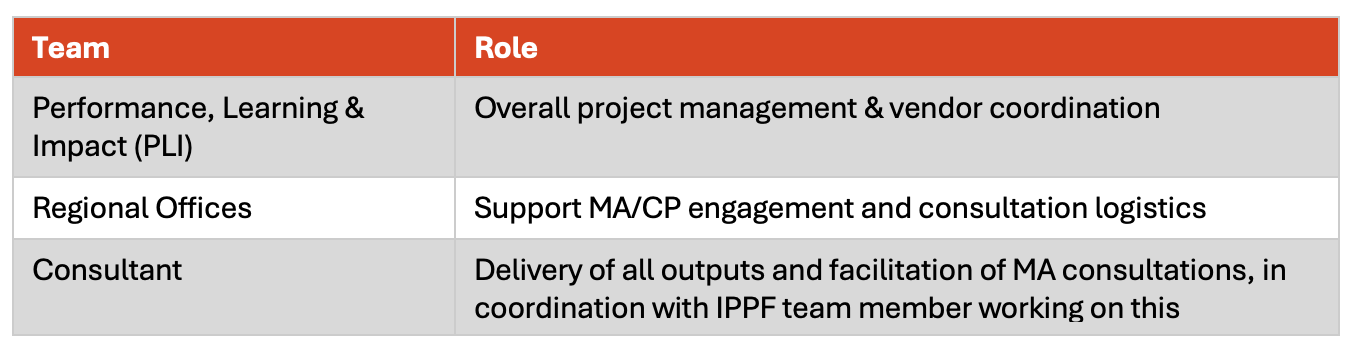
6. Reporting & Coordination
7. Budget & Payment Structure
Payment will be made in tranches linked to milestone deliverables, as agreed in the final workplan. The indicative budget for this consultancy will be confirmed upon scoping of proposals received.
8. Confidentiality & Data Protection
The consultant must comply with IPPF’s Data Protection Policy. No raw data or consultation outputs will be stored or shared externally without prior written consent from IPPF. All materials developed under this consultancy remain the intellectual property of IPPF.
9. Proposal Submission Requirements
Interested consultants should submit the following to mbrown@ippf.org with the subject line “Proposal for Vulnerability Assessment” by Monday, 25th May, 2026:
Technical Proposal (5 pages maximum)
- Contact information: Include your name, address, and contact information.
- Relevant experience: Describe relevant projects and contextual knowledge.
- Approach and methodology: Outline the proposed approach and methodology. Include risks and mitigation strategies, a proposed work plan, and team roles.
Annexes
- CV(s) of the lead consultant and any team members.
- Two samples of relevant previous work (e.g. toolkits, guidance documents, or assessment reports).
- Contact details of two professional references.
Financial Proposal
- The budget for this consultancy is USD $12,000. Translation costs for the final documents are not included in this budget and can be covered directly by IPPF.
- A financial proposal with a detailed line-item budget as shown below. Payments will align with deliverables, as agreed at contract signing.
