



As Israeli strikes continue to drive mass displacement, casualties and destruction across Lebanon, SALAMA’s Executive Director Lina Sabra reflects on what it means to keep sexual and reproductive healthcare alive in a widening crisis.
Since the latest war began on March 2nd , families across Lebanon have been fleeing Israeli attacks. More than one million people have now been displaced, and evacuation orders affect around 14 per cent of the country's territory.
This escalation is unfolding amid the wider regional war, and there is a serious risk that Lebanon may once again bear the brunt of larger geopolitical agendas and be sidelined and overlooked. “They are using this moment as an opportunity for more attacks” says Lina Sabra, Executive Director of SALAMA, IPPF's Member Association in Lebanon. “That is how it feels to us. And it is our communities who are bearing the devastating consequences.”
For women, girls and marginalised communities, the consequences are severe. Sexual and reproductive healthcare becomes harder to reach at the exact moment the need for it becomes more urgent. In the middle of bombing, pregnancy does not stop. Babies will still be born, in hospitals where they are still functioning, or elsewhere when they are not. Postnatal complications still require care to prevent maternal deaths. People still need contraception, medicines and menstrual hygiene supplies.
Women and marginalised communities also face heightened risks of sexual and gender-based violence during humanitarian crises and need trusted, timely care. Yet these services are too often treated as secondary, even though they are central to women’s and girls’ health, dignity and survival.
"Women, girls and young people are paying the price for this war in ways that are not always visible," says Lina. "Their health, safety and futures are being damaged."
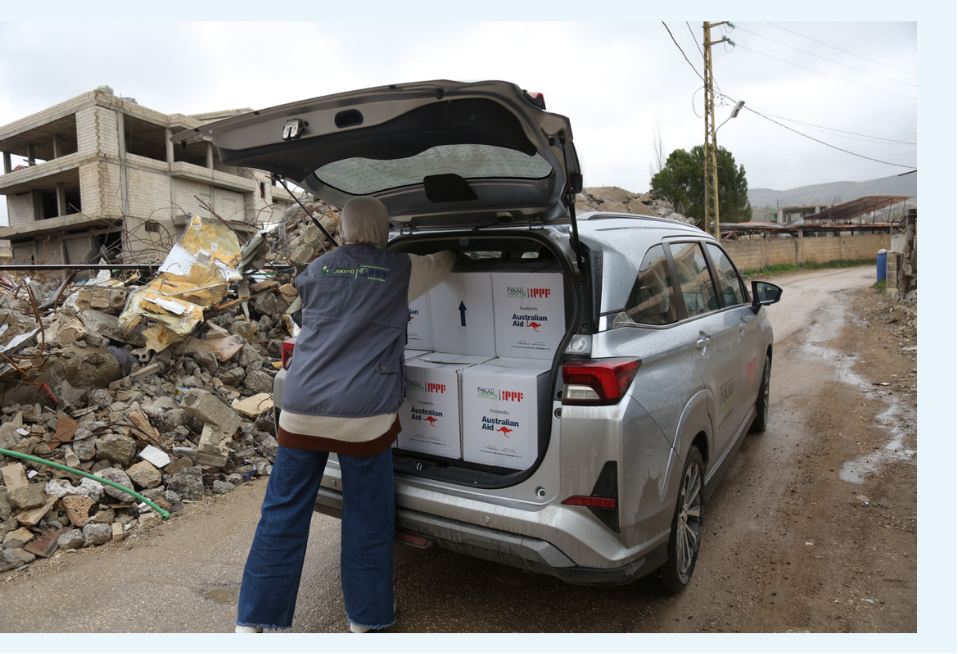
With support from IPPF and funding from the Government of Australia, SALAMA continues to respond every day on the ground in the Bekaa Valley in eastern Lebanon.
Keeping services alive under fire
National and local organisations, like SALAMA, are not standing outside the crisis looking in. They are living it while responding to it.
"In the Bekaa, there are attacks every day," Lina says. "There are always warplanes, always strikes, always uncertainty. People are leaving their homes in the middle of the night when warnings come, or sometimes with no warning at all…My own family has spent one of the most terrifying nights in the car after fleeing. Staff have also been displaced. One day they are working, the next day they may have to leave their home, their town."
Lina describes an assault that is targeting civilians indiscriminately. "The attacks are not only on homes and towns...they are attacking the displaced people and the camps,” Lina says. “They attacked people sheltering on the beach. They attacked the Lebanese University, killing two doctors and two scientists. And after the strikes, when the medical teams go to help, they attack them too.”
No one can predict where the next strike will land or how far the conflict will spread, and Lina is worried about the uncertainty. “I have no clue. No one has. Nobody knows. Trump himself, he doesn't know. Humanitarian response cannot wait for clarity that may never come."
As people flee the south and Beirut, the Bekaa has become one of the key destinations for displaced people, with families arriving in Zahlé, were SALAMA has a clinic, and the surrounding towns in large numbers. "Many are in schools. Others are in unfinished buildings or rented apartments, where landlords are multiplying costs four times over. In some places there is furniture and water. In others, there is almost nothing.”
Of the more than one million people now displaced, as of March 26th, only 136,262 are registered across 663 official shelters. The rest are largely invisible to the formal system.
"Many of the most vulnerable people are not in official shelters at all. They are in empty buildings, overcrowded apartments, with relatives, in places no one has formally registered. These are the people most likely to be missed, because most organisations focus on official sites. We try to reach both. Sometimes beneficiaries call us directly. Sometimes municipalities call us. Sometimes relatives tell us where families are staying. Last time, when I saw a building full of displaced families, I would go inside and ask who was responsible so we could organise distributions. This is how we work. We follow where people are."
SALAMA is a small organisation, with eight staff and around 200 volunteers, but although one of its clinics has had to close, it has not stopped and it’s impact is huge.
The clinic in Zahlé is providing direct clinical care, including consultations, family planning services and referrals for women who need specialist support. In the displacement shelters, SALAMA's teams are running awareness sessions, providing psychosocial support and connecting people to referral pathways for further care. Food vouchers are also being distributed to the families who need them most, with pregnant and breastfeeding women prioritised. For many of the women SALAMA reaches this combination of care, information and practical support is the only SRHiE care available.
"Postnatal care is especially overlooked in a crisis”, Lina says, "Deliveries may not be safe. Women may lose access to family planning methods and other essential commodities. There are also wider health concerns linked to overcrowding, stress and poor living conditions."
"Part of the team is working inside the clinic, while others are out in shelters and towns distributing dignity kits and mama and baby kits. We are using the supplies we already have, including remaining kits from IPPFs previous support and additional items received through UNFPA."
SALAMA is also formally integrated into the wider humanitarian architecture, coordinating with UNFPA, UNHCR, the NGO platform and the Ministry of Public Health as part of the national response. "This is different from previous escalations," Lina says. "Before, we were often responding more independently. Now we are a wider ally of the humanitarian system, reporting activities and contributing to the national dashboard. That matters, because it helps make sexual and reproductive health in emergencies visible."
What has driven that response, Lina says, is the commitment of the people delivering it. "What has stayed with me most is that our staff did not wait to be told what to do. They came forward and said they wanted to help. They wanted to go to the clinics. They wanted to support displaced people. Of course I worry about them, about their safety, about my family, about our volunteers. We assess the situation every day and adjust. But the commitment of the team is extraordinary."
Rooted, trusted, ready
SALAMA's strength lies not only in speed, but in the relationships that make that speed possible. Those relationships were built through the escalation of October 2024, which became a defining learning curve for the organisation.
"What we have learned from previous responses has made a real difference," Lina says. "We are better prepared now because we have already lived through the worst-case scenarios. We know how to adapt. We know how to work in a fluid, fast-changing crisis."
"Our staff and volunteers are from the communities affected, so they know the people, the places and the changing realities on the ground. We have direct relationships with beneficiaries, community leaders, municipalities, ministries and partners. They allow us to act quickly, identify gaps and solve problems in real time. We do not need to wait through layers of procedures before making decisions. I can take a decision, inform the staff on WhatsApp, and we move. As a local organisation, that gives us strengths that international organisations often do not have," Lina says.
"Every dollar goes into the response. We are not spending money on international salaries, conferences or layers of administration. We use volunteers. We use existing clinics in the community. We adapt activities based on the situation. In war, nothing is static. People move again and again, often with no certainty about where they will end up or whether they can return. To support them, you have to be where they are."
The question for humanitarian leaders and donors is a simple one: if organisations like SALAMA are already coordinated, already delivering and already trusted by the communities they serve, why are they still too often underfunded, and treated as implementers rather than leaders?
Lina is clear about what she needs the international community to hear.
"We need support that reaches communities through national organisations that are already there, already trusted and already responding," she says. "We need funding for services, for dignity, for health, for development. My message to donors is simple: fund communities through national NGOs."
To governments, her message is equally clear.
"Stop financing weapons and conflict. Girls' futures are being destroyed."
She pauses.
"We just need the war to stop."
when
country
Lebanon
region
Arab World
Subject
Humanitarian
Related Member Association
Lebanese Association for Family Health