



In a moment of overlapping crisis and intensifying backlash around human rights, gender equality and sexual and reproductive health, rights and justice - globally and in the UN - the stakes are high at the 70th session of the Commission of the Status of Women (CSW).
Across the globe, women, girls and marginalized communities continue to suffer disproportionately from lack of equality and human rights violations, with immense barriers for their access to justice. At the same time, governments are cutting funding and scaling back support for basic lifesaving assistance for the most marginalized and vulnerable. Now more than ever, we need concerted action to advance our rights, hold governments accountable for their commitments and strengthen global cooperation.
IPPF therefore welcomes the adoption of the Agreed Conclusions on this year’s important priority theme on: Ensuring and strengthening access to justice for all women and girls.
US Isolation
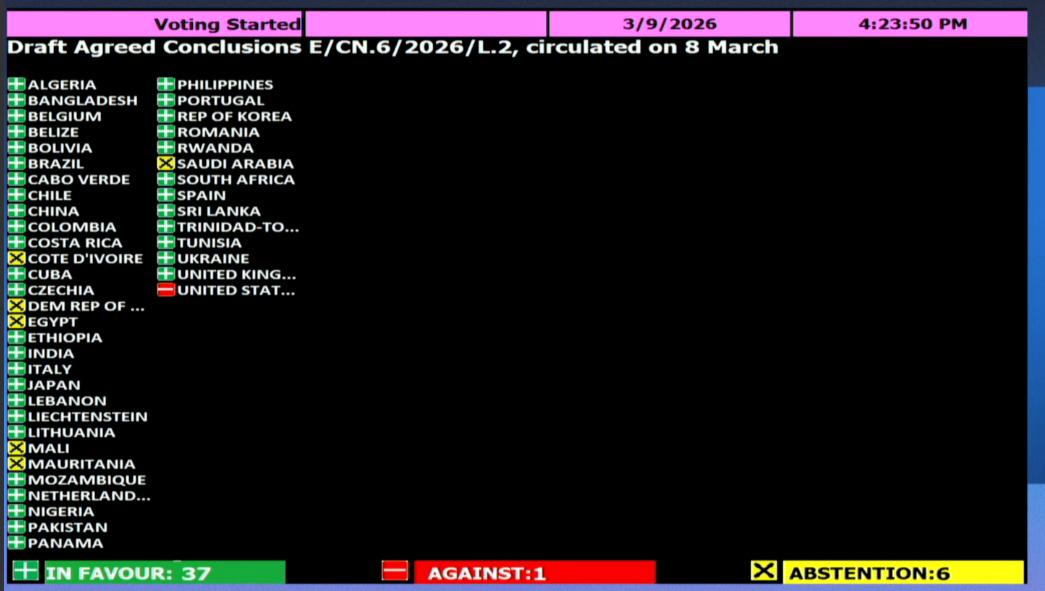
We regret that a small minority group of countries, led by the USA, undermined possibilities for reaching consensus and that the USA called for a vote on the text. However, the voting result speaks clearly for itself: Despite concerted ongoing attacks on human rights and multilateralism, the overwhelming majority of UN Member States - from all regional groups - share a commitment to implementing the Beijing Agenda and achieving gender equality for all women and girls and those facing multiple and intersecting forms of discrimination. In fact, only the USA voted against it. In this current geopolitical context, the adopted outcome is sending a strong signal about the importance of the Commission’s mandate and continued global cooperation within the multilateral system.
IPPF particularly welcomes that the adopted Agreed Conclusions include:
- The commitment to ensure universal access to sexual and reproductive health and reproductive rights. We also welcome the commitment to ensuring sustainable resources to holistic survivor-centered services, including for sexual and reproductive health, as this is of paramount importance in terms of ensuring long-term, multilayered, comprehensive support for survivors.
- Reaffirmation of the International Conference on Population and Development and its Programme of Action and its follow-up, given the critical complementary and mutually reinforcing nature of the ICPD Programme of Action to the Beijing Platform for Action in ensuring the realization of human rights, including sexual and reproductive health and rights, for all women and girls.
- Strong language on preventing and responding to sexual and gender-based violence, including GBV that occurs through or is amplified by technology, as the rapid digitalisation and evolution of technologies presents new challenges and requires regulation and safeguards to address, prevent and eliminate violations of rights and gender-based violence perpetrated online.
- The inclusion of a specific focus on access to justice and reparations in humanitarian, conflict and post-conflict settings, including by strengthening legislation and taking proactive steps to prevent, investigate and prosecute sexual violence in conflict.
- The reference to multiple and intersecting forms of discrimination as a key barrier for access to justice and a major impediment for achieving gender equality.
- The recognition of the need for safe and enabling environments for civil society engaged in access to justice initiatives for women and girls, including through sustaining access, as appropriate, to core, predictable, flexible and multiyear funding.
Key Gaps
However, IPPF is concerned about key gaps in the text that significantly weakens its scope. The removal - due to significant pressure from a group of conservative States - on language linking the theme of access to justice and sexual and reproductive health and rights weakens accountability for some of the most prevalent violations that women, girls and marginalized groups are facing. Moreover, the draft omits references to bodily autonomy, which is the normative foundation of any rights‑based approach to access to justice; without it, commitments risk remaining abstract. These omissions are particularly concerning in a global context marked by increased anti‑rights influence, substantial financial pressures on SRHR, and institutional reforms that may affect the UN’s gender equality and human rights architecture
IPPF now urges all governments to unite behind this crucial call to action.The true impact of this outcome will be measured by its implementation at the national level. As a locally rooted yet globally connected Federation, IPPF and its Member Associations are uniquely positioned to drive and support the implementation of these commitments across national, regional, and global spheres. By doing so, we can ensure meaningful change in the lives of women, adolescents, girls, and other marginalized communities where it matters most.
when